1964 Plymouth HEMI Nostalgia Super Stock: 471 Cross-Ram Build & Track Breakdown (Copy)
https://youtu.be/WZxWZ53Po8w?si=lrGUWEeCd1fEXq_R
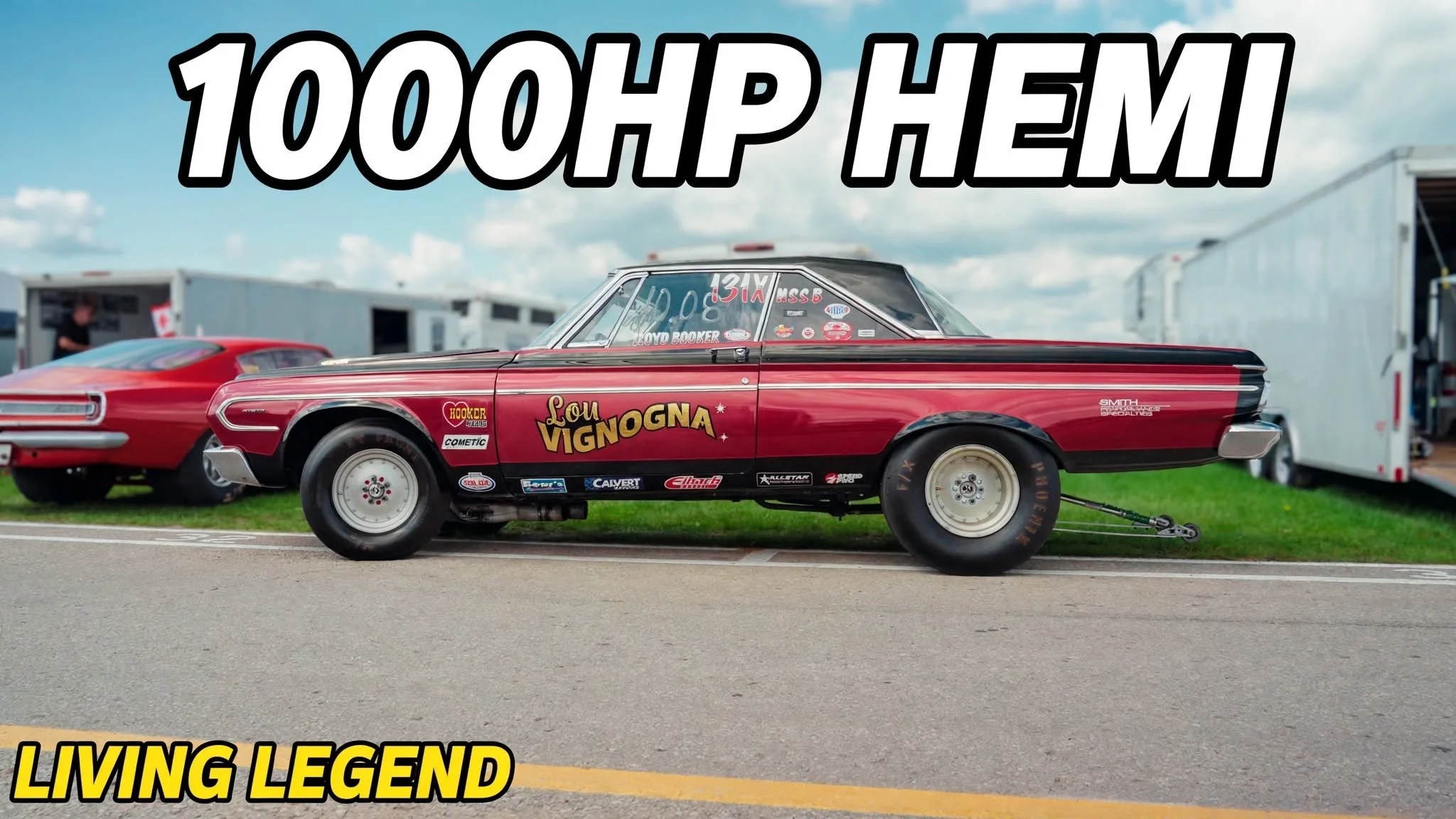
Nostalgia Super Stock preserves the golden era of factory-backed drag racing, but the hardware required to keep a 60-year-old B-body running consistent single-digit passes is pure execution.
We caught up with the owner of this legendary 1964 Plymouth HEMI in the pits at Toronto Motorsports Park to break down the mechanical layout, historical lineage, and track performance of a verified vintage drag build.
Proven Drag Racing Lineage
This chassis carries legitimate Mopar racing history. Sourced out of New York State, the car was originally built and campaigned for years by Lou Vigoli under direct Mopar sponsorship during the peak of the Super Stock era. Following Vigoli’s passing, both of his race cars were brought across the border into Canada, where the current owner acquired this vehicle to compete in the Nostalgia Super Stock class.
Unlike modern bracket racing with strict index clamps, Nostalgia Super Stock regulations allow for open displacement while retaining period-correct architecture, body lines, and legal induction systems.
Powertrain & Induction Architecture
The core of the build relies on a balance between vintage NHRA legality and repeatable track reliability rather than an oversized crate setup:
Engine Displacement: 471 Cubic Inch Chrysler HEMI
Induction: Period-correct Cross Ram intake manifold with dual 4-barrel carburetors
Output: Approximately 800 flywheel horsepower
Transmission: Race-prepped Chrysler 727 TorqueFlite automatic with upgraded internal planetary sets and high-stall converter
Rear Differential: Dana 60 housing with 4.56 ring-and-pinion gearing
The cross-ram manifold setup delivers the air-fuel volume necessary to feed the 471ci displacement at high RPM, though its runner design makes low-speed street manners non-existent. It is built strictly for wide-open-throttle quarter-mile passes.
Chassis, Suspension & Weight Optimization
To push an early B-body into single-digit territory with 800 horsepower, chassis rigidity and unsprung weight control take priority over creature comforts:
Rear Suspension: Fully converted to a double-adjustable coilover rear setup, completely deleting the factory rear leaf springs for precise rebound and compression tuning.
Front Suspension: Retained period-correct Chrysler torsion bar configuration.
Chassis Weight: Scaled at 3,200 lbs race weight.
Lightweight Modifications: Gutted inner door skins, lightweight polycarbonate windshield, and stripped interior tinwork.
Track Performance & Real-World Variables
Baseline quarter-mile performance for this chassis sits reliably in the 9.90-second bracket in clean, cool air.
During track testing in high-density altitude and heavy summer ambient heat, the car posted a 10.08-second pass. Mechanical drag racing demands constant adaptation: off the hit on pass one, the Plymouth carried the front wheels in a hard, extended wheelie, forcing an immediate pedal to save the pass. The subsequent hard landing slightly dented the oil pan, but the bottom end maintained full oil pressure with zero structural compromise.
Watch the full pit-lane walkaround and mechanical interview above to see the cross-ram HEMI fired up and running in the staging lanes.