Car vs Motorcycle Drag Racing: Mopar Trackhawks & SRTs vs Stretched BIKES
https://youtu.be/TYugfnsruXQ?si=8xazMp14Bem1FMye
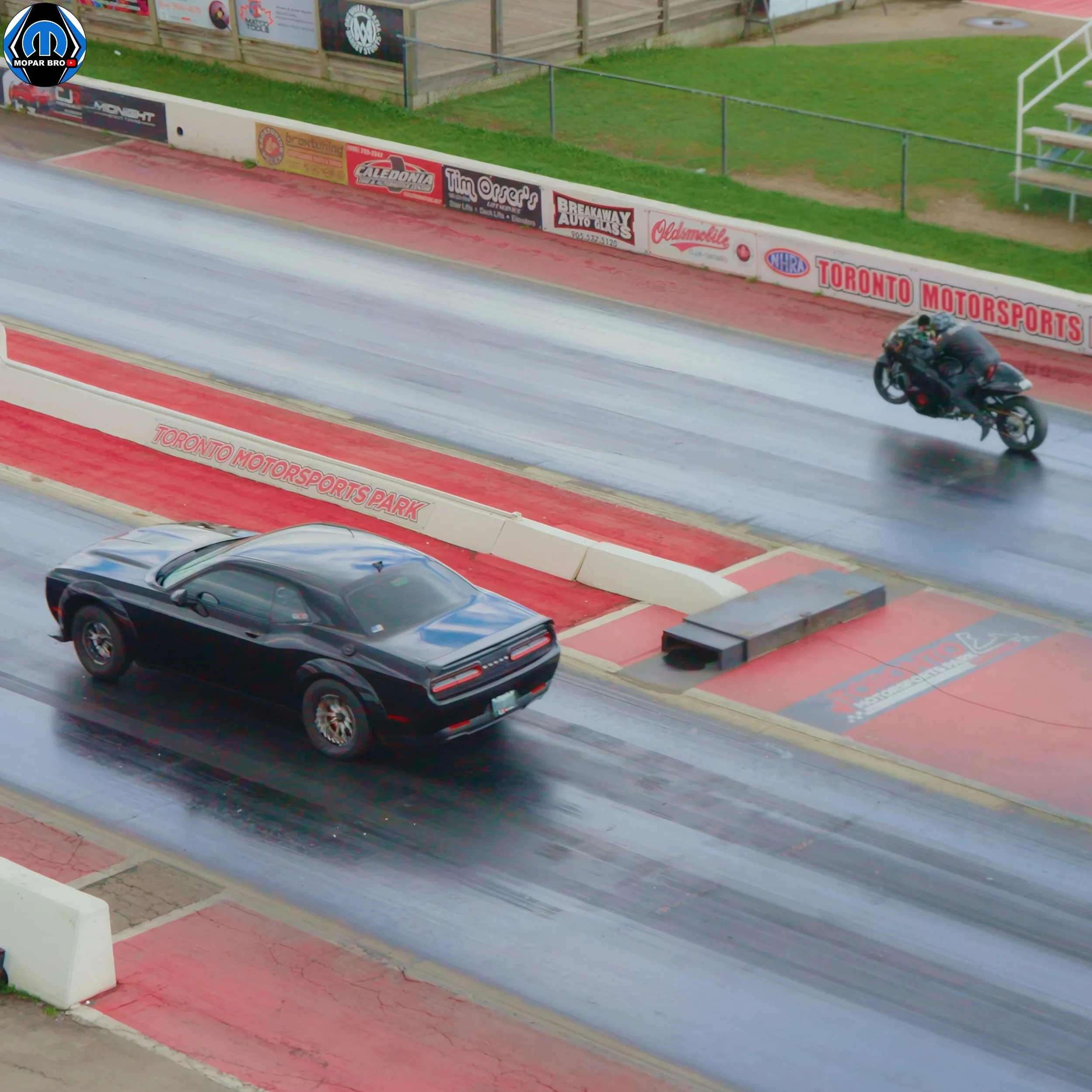
The quarter-mile data from this matchup provides a definitive look at the extreme mechanical friction between massive power-to-weight advantages and absolute drivetrain efficiency. When you line up a 4,500-pound supercharged domestic muscle car or a 6,000-pound AWD SUV against a 400-pound motorcycle, standard drag racing physics are fundamentally stressed.
This is a technical breakdown of how modern Dodge Challenger SRT Hellcats and Jeep Grand Cherokee Trackhawks compete against heavily modified, stretched 1000cc superbikes on a prepped track.
https://youtu.be/TYugfnsruXQ?si=8xazMp14Bem1FMye
Launch Mechanics: The Extended Swingarm vs. Drag Radials
The most critical data point in a car versus motorcycle drag race is the sixty-foot time.
A standard inline-four 1000cc motorcycle pushing 200+ horsepower boasts an untouchable power-to-weight ratio, but it faces a severe mechanical limitation off the line: rotational force. Without modifications, hard acceleration immediately lifts the front wheel, forcing the rider to back off the throttle.
To counteract this, the drag bikes in this footage utilize extended swingarms. Stretching the wheelbase fundamentally alters the motorcycle's center of gravity, moving the rear axle further behind the engine mass. This allows the rider to deploy significantly more torque to the rear tire without looping the bike. However, they are still transferring all that energy through a contact patch the size of a credit card.
Conversely, the Dodge Challenger SRT Hellcat Widebodies rely on massive 315-section rear drag radials. While the Hellcat battles a 4,500-pound curb weight, it utilizes superior traction management and suspension squat to efficiently transfer its 707+ lb-ft of torque to the VHT, providing extreme consistency off the transbrake or footbrake.
The AWD Drivetrain Anomaly: Jeep Grand Cherokee Trackhawk
The mechanical dynamic shifts entirely when the Jeep Grand Cherokee Trackhawk enters the staging beams.
On paper, a 6,000-pound SUV should be completely obliterated by a 1000cc superbike in the first 330 feet. Instead, the Trackhawk completely neutralizes the motorcycle's power-to-weight advantage through advanced drivetrain geometry. The Jeep utilizes a highly reinforced active transfer case and electronic limited-slip rear differential to instantly distribute 707 horsepower to all four wheels.
When the Trackhawk driver utilizes the factory launch control, the ECU perfectly modulates engine torque to match available grip. This results in a brutal, zero-wheelspin launch that visually matches the initial hit of a highly tuned drag bike, proving the superiority of modern AWD mechanical grip over raw, two-wheel power-to-weight ratios.
Aerodynamic Drag Coefficients at the Top End
Beyond the 660-foot mark, the race transitions from a battle of traction to a battle of aerodynamics.
While a motorcycle is exceptionally light, a rider sitting upright creates severe aerodynamic drag. At 150mph, a motorcycle acts like an aerodynamic brick. This is where the sheer volumetric efficiency of the 6.2L supercharged HEMI V8 takes over. Despite their immense weight, the Challenger and Charger platforms have the frontal area and the sustained horsepower required to punch a hole through the air, allowing them to rapidly close the gap and aggressively pull on the superbikes at the top end of the track.
For more technical drag racing data, HEMI maintenance breakdowns, and high-fidelity automotive media, subscribe to the channel and explore the technical library at moparbro.com.